
After the unity and community care that followed 9/11, we have become more isolated, polarized, and intolerant than ever. That tragedy wasn’t the only turning point, but it did mark a dramatic shift from collective responsibility toward hyper-individualism and division.
How can we rebuild trust—in one another, our communities, and our institutions? If this is who we are now, how do we move forward, differently? These days, I often reflect on antidotes to isolation and fear, and it’s not so complicated. Maybe the prison garden story below offers some answers, and some hope, too.
A Retrospective
Turning both inward (what am I going to do with the rest of my life after THIS?), and outward (what can we build together?), a series of synchronistic events led me to starting a gardening program at San Quentin Prison in 2002, exactly a year after 9/11. I figured if I could find humanity in a prison, I could find it anywhere.
Despite the complexity, fear, and militaristic culture of the prison system, several guiding principles and practical approaches contributed to the successful installation of our first garden.
What Rooted Us
- Relationship-building: Taking the time to develop relationships with CDCR leadership and staff, the people living inside, and one another, created the foundation for the work.
- Accountability and commitment: Showing up, being present, contributing, and setting boundaries when necessary fostered a shared commitment among volunteers and the men living inside.
- Trust in the process: Remaining grounded in our simple yet powerful vision and mission—reconnection to self, community, and the natural world—allowed us to move forward without needing to control every outcome.
How We Cultivated Change
- Responding rather than reacting: A thoughtful and intentional response to challenges helped us navigate the institutional push and pull. Securing project approvals often required patience, negotiation, and persistence to move from “no” toward “yes.”
- Perseverance: The understanding that people working together are more powerful than anyone acting alone sustained us through ongoing barriers and a rigid hierarchy.
- Resilience and adaptability: Remaining flexible and nimble allowed us to adjust as institutional conditions, expectations, and leadership continually changed.
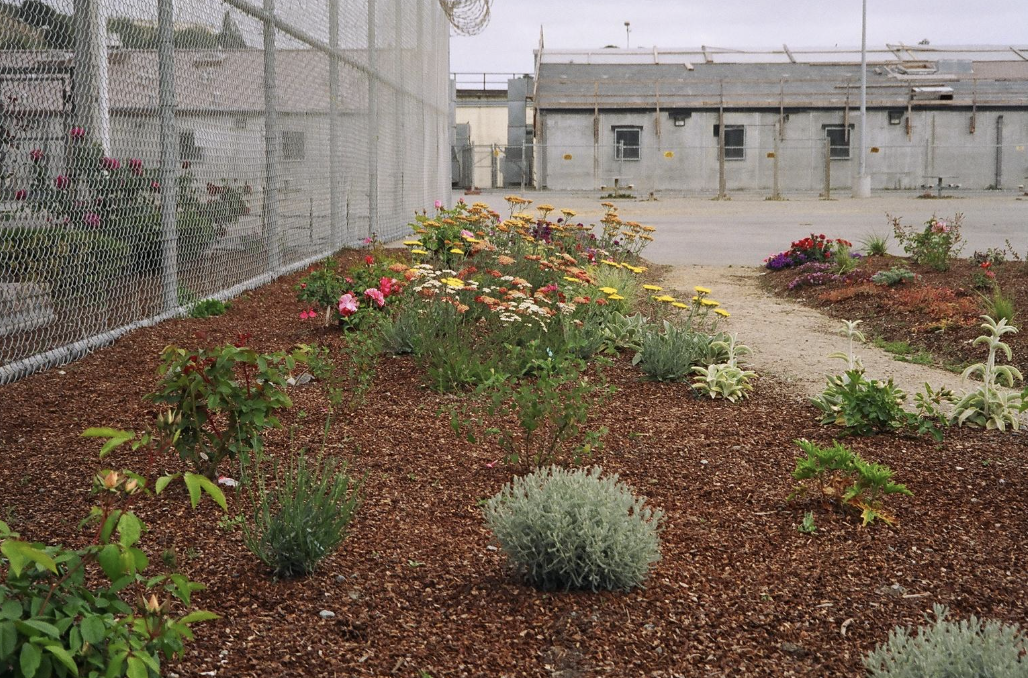
The result? All involved came together to navigate a complex and difficult system and accomplish what felt like a miracle: creating an open garden on a prison yard. And we began with ourselves, modeling the change we wanted to see in the world. We built community by nurturing relationships, listening and learning to understand, being curious and empathic, and taking action.
Now
Over this past 25 years, taking from lessons learned inside, I’ve been struck by a few writers and thinkers who are deeply embedded in “community” to build bridges instead of walls: Peter Block’s book “Community: the Structure of Belonging;” Loretta Ross’s work on “Calling In” (instead of calling out); and Dr. Vivek Murthy (our former Surgeon General) who has made loneliness, social isolation, and the importance of human connection central themes of his work.
Can we let go of the fears that isolate us by being truly present with others? Letting go of fear also creates more space to connect!
What approaches can we use, in the face of all of the polarization, to listen and learn, find empathy, and build new bridges? Dr. Murthy suggests we start with…love.

“Right now, the world you are inheriting is locked in a struggle between love and fear. Fear manifests as anger, insecurity, and loneliness. Fear eats away at our society, leaving all of us less whole, so we teach you that every healthy relationship inspires love, not fear.
Love shows up as kindness, generosity, and compassion. It is healing. It makes us more whole. The greatest gift to ever receive will come through these relationships. The most meaningful connections may last for a few moments, or for a lifetime, but each will be a reminder that we were meant to be a part of one another’s lives, to lift one another up, to reach heights together, greater than any of us could reach on our own.
Our hope is that you will always have friends in your lives who love and remind you of your innate beauty, strength, and compassion. Equally as important, we hope you will do the same for others.
It pains us that we won’t always be there for you when you feel lonely and sad, but we offer this simple prescription to remind you, you are loved. When those moments of loneliness and suffering arise, take both your hands and place them on your heart and close your eyes. Think about the friends and family who have been there for you throughout your life, in moments of joy, and also in the depths of disappointment, the people who have listened to you when you were sad, the people who believed in you, even when you lost faith in yourself, the people who have held you up, lifted you, and seeing you for who you really are.
Feel their warmth and their kindness washing over you, filling you with happiness. Now, open your eyes.”
—Vivek H. Murthy, Together: Why Social Connection Holds the Key to Better Health, Higher Performance, and Greater Happiness


Beautiful Beth – thank you
I really like this message!
Love you!
>
Beth, A beautiful vision that we desperately need right now. We’ve lost our civility let’s hope that somehow we can find our way back. Much love, Your Uncle