
These days, we need every strategy available to stay grounded by cultivating kindness and compassion for ourselves and each other. Deepening the interconnections with self, community, and the natural world can help transcend the current polycrises.
My next series of blogs (starting with this one), explores “gardening” from the inside-out and the outside-in, offering a lens through which we can understand our place in the greater web of life. This perspective was rooted in the core philosophy of the Insight Garden Program (now Land Together): transforming lives through connection to self, community, and the natural world. If we can ground ourselves in these interconnections, we’re more likely to build resilience and less likely to harm that which sustains us.
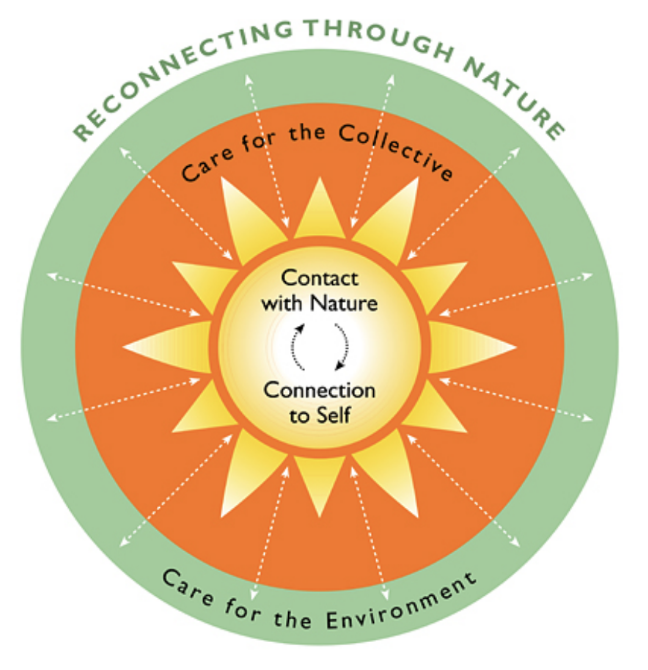
Connection to Self —We are literally nested systems of cells, tissues, organs, and bacteria, all coexisting in intricate symbiosis. All parts of us function in alignment, flowing through cycles of growth, decay, and renewal. And what distinguishes us from other living beings is our capacity for consciousness and self-awareness – our “inner garden.”
Care for the Collective — Families, friends, colleagues, communities, organizations, cultures, and broader social systems shape our world, offering belonging and purpose. They invite us to transcend the limited view of the individual self and step into something more expansive, mysterious, and transformative.
Interdependence with the Natural World —Air, water, soil, plants, animals, and ultimately the cosmos are essential for our survival. We are, quite literally, made of stardust. Without the Earth’s living systems, we would cease to exist.
Tending the Inner Garden
Cultivating self-awareness is the underlying thread of every book I’ve read in the past few months* as a necessary foundation for personal growth, trust-building, community-building, and making a difference. We really don’t have much control over anything other than how we show up in the world. Our energy, intentions, and presence shape not just our own experience but also influences the people and systems around us.
For instance, Murray Bowen’s family systems theory posits that it only takes one person to transform the functioning of a system…which is a truth that has played out in my life time and time again. If one changes behavior in relation to others, systems do, indeed, shift. And it’s a lifelong journey to practice changing how we show up in relation to those closest to us, and beyond.
The Four Stages of Awareness
Recently I discovered Ken Wilber’ Four Stages of Consciousness which provides a powerful lens for understanding why people relate (or clash) the way they do and why conflict/misunderstandings can ensue. Many of our greatest tensions come not from disagreement, but from people speaking from different levels of consciousness. All the more reason to use inquiry to understand people’s lived experiences, and then “meet them where they are…” (see the addendum below for further explanation and examples).
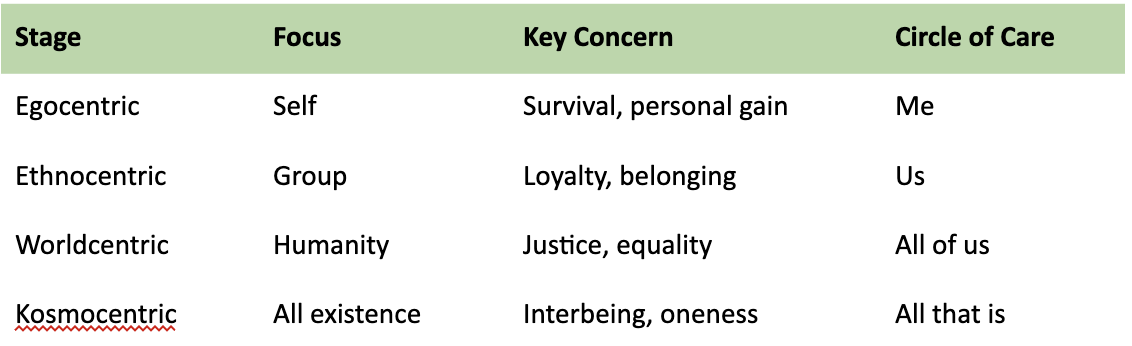
Having a deep understanding of our inner dynamics—values, biases, emotional triggers, past traumas, and patterns of behavior — can help surface “blind spots,” “saboteurs,” and “shadow” selves. Self-reflection provides insight into how to show up differently and move through these stages of awareness. It also provides an opportunity to learn to respond rather than react – fostering healthy relationships that can support the greater good, and long-term, meaningful change.
What Holds Us Back?
Self talk. Are the stories we tell ourselves really true? Or do we cling to identities that no longer serve us?
Reaction vs. response are built into the flight or fight part of the brain (amygdala) vs. the prefrontal cortex (rational, impulse control) where we cultivate self awareness and response.
Fear of the unknown. Since the past has already happened, and the future is unknown, learning to focus on the present is a path worth taking (which is actually the only thing over which we do have control!)
Blind spots. Our traumas, shadows, and “saboteurs” which lead to reaction (instead of response) unless we surface them to move into something different.
Ways Forward
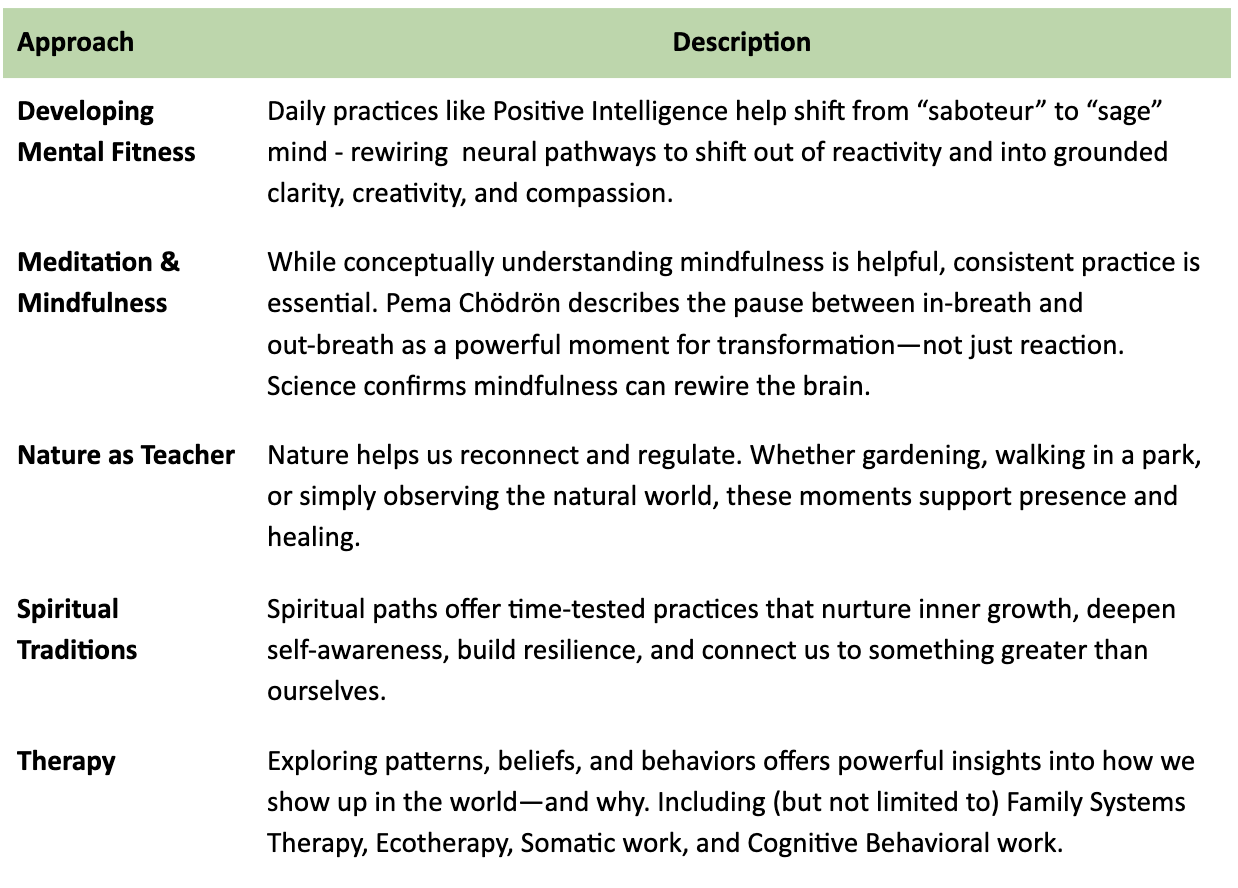
While transformation can strike suddenly in an “Aha” moment (and/or designed and facilitated opportunities to elicit these moments), it more than often arises through intention. Countless tools exist to practice presence and literally rewire how our neurons fire—and it’s never too late to start! Cultivating awareness can include:
Exercise
What are the stages of awareness may apply to you? And how you might explore “ways forward” to increase your level of self-awareness/reflection?
When you think about your own responses or reactions as ripples, what kind of ripple do you want to create?
Are there specific practices or mindsets you lean on to deepen awareness in more challenging moments?
*Worth a Read!
Loretta J Ross: Calling In: How to start making change with those you’d rather cancel
Connie Zweig: The Inner Work of Age: Shifting from Role to Soul
Deepak Chopra: Digital Dharma – How AI can elevate spiritual intelligence
Positive Intelligence: Mental Fitness
Graphic Above: courtesy of Diane Rigoli
The outward work will never be small if the inward work is great.
Meister Eckhart
Addendum
A more thorough description of the Four Levels of Awareness is presented below – and how these stages often play out in relationships, workplaces, movements, and misunderstandings:
1. Egocentric (Me) – “I need to survive”
How it shows up: Self-focused behavior, often unaware of impact on others. Decisions are based on instinct, impulse, or personal gain.
In conflict: Little capacity for empathy or self-reflection. Misunderstandings arise from a lack of awareness that others have different needs or realities.
Examples: A leader who hoards power, or someone who lashes out when they feel threatened without understanding why.
2. Ethnocentric (Us) – “I belong if I conform”
How it shows up: Strong group identity and loyalty, often through family, religion, culture, political party, or profession.
In conflict: Tends to “other” people outside the group. Misunderstandings often happen because of rigid rules, judgment, or moral superiority.
Examples: An organization that values “how we’ve always done it” over innovation. Culture wars. “You’re either with us or against us” dynamics.
3. Worldcentric (All of Us) – “I see the bigger picture”
How it shows up: Compassion extends beyond tribe or group. There’s appreciation for diverse perspectives, cultures, and systems thinking.
In conflict: Seeks understanding, holds paradox, and prioritizes shared humanity. Misunderstandings may arise when interacting with people at earlier stages, as the flexibility can seem threatening or disloyal.
Examples: Global justice movements, inclusive leadership, bridge-builders across differences.
4. Kosmocentric (All that Is) – “I am part of the whole”
How it shows up: Deep humility and non-attachment. Identity expands beyond human systems to include the Earth, cosmos, and spirit. Acts from love rather than ego or ideology.
In conflict: Often misunderstood as passive or idealistic. But action flows from deep alignment, not from ego needs or group identity.
Examples: Mystics, wisdom keepers, visionary leaders, or even ordinary people who radiate grounded presence.
Why This Matters in the World Today
How these stages work in society:
A person at worldcentric stage might try to engage a group at the ethnocentric level with logic and openness—and be met with suspicion or rejection. Instead, meeting people “where they are” is critical for understanding context through meaningful dialogue. Similarly, someone at egocentric may view calls for justice or inclusion as personal threats rather than systemic shifts.

 Beth Waitkus
❤️
Beth,
Thoroughly enjoyed your first foray into cognitive awareness. Looking forward to your next edition.
Roddy
Beth – love the title and so glad your continuing your journey on this work – let me know if you head East it would be terrific to catch up